~ Pre-K & Preschool theme ideas for learning about dinosaurs ~
Books
Information Books:
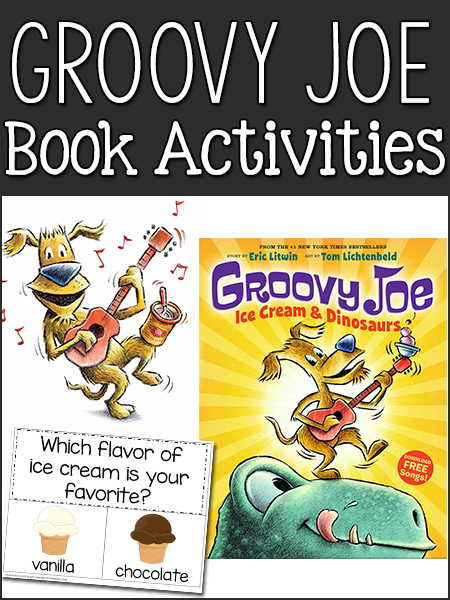
Fiction Books:
Songs
- The Dino Pokey, by Mrs. Jones
- Dinosaur Theme Links: my bookmarks at del.icio.us
- Dinosaur Theme @ Pre-KPages.com
- Dinosaurs @ Enchanted Learning
Activities
Dinosaur Herd
[Large Motor]
Brontosauruses and triceratops traveled in herds. Children are put into two groups: brontosaurus and triceratops. The groups travel (crawl)
to various destinations around the classroom together in their herd. They must stay with the herd and not get lost!
Play Dough Skeletons
[Fine Motor Skills]
Children pretend to be paleontologists who have discovered bones (pasta) in the ground. We have to figure out how to put the bones together
to make a dinosaur. They mash play dough flat on a plate. We use a dinosaur-shaped cookie cutter to make the outline of a dinosaur in the play dough.
Then press pasta shapes (bones) into the play dough inside the outline to make a skeleton. Model Magic or self-hardening clay would also work well.
Dinosaur Stencil Books
[Fine Motor Skills]
Children make a book with paper and stapler. They trace dinosaur stencils with markers onto the pages of the book. Many children ask me to spell
the dinosaur names so they can write them in the book.
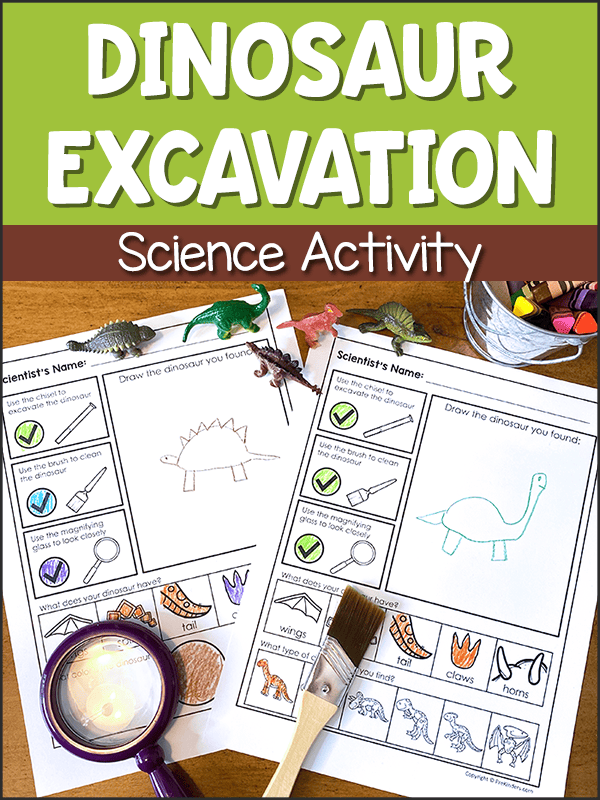
Fossils
[Fine Motor Skills, Science]
We add small toy dinosaurs with the play dough. Children make dinosaur fossils and footprints in the play dough. Children use this at center
time for exploration. We also make one dinosaur fossil using Mexican self-hardening clay which the children can keep.
Dinosaur Skeletons
[Fine Motor Skills]
Dinosaur Skeleton Printable
Children assemble and glue pieces of the dinosaur skeleton to a piece of construction paper (12x18), and glue dry pasta on the skeleton.
Pasta:
Shell for the Skull
Rigatoni for the Legs
Fettucini for Ribs
Elbow (Macaroni) for the Neck, Backbone, & Tail
Reprinted here with permission from the former owner of "Kindernet Online"
"If You Take a T-Rex to School" Class Book
[Literacy]
We read the book "If You Take a Mouse to School" and make a dinosaur book patterned after that story. Children choose a dinosaur to draw,
and think of what might happen if that dinosaur came to school. The teachers write the children's dictation on the pages, and put the pages together
to make a book. To make our class books, I use "presentation book covers" from an office supply store or Walmart. It has a sturdy plastic cover with a clear insert,
and the pages are also clear inserts. I just slip in a page for the front cover, and slip in the children's pages inside. These can be reused.
Story Retelling
[Literacy]
Choose a dinosaur-themed book that you would consider good literature (good characters, plot, beginning, middle, end, etc.) Show the book to the children
and tell them to think about what happened in the story, and the people (characters) and places they saw in the story. Think about what each character
said. Give each child a piece of paper and ask them to draw something they remember from the story. Remind them that this should not be a picture of their
cat or their friends, but only pictures of things from the book. After each child has illustrated the story, have them retell the story in their own words.
Either record each child with a voice recorder or write their dictation on the page.
Dino Stamping Game
[Math, Literacy]
Write a letter or numeral on each dinosaur, and make a copy for each child. Children will draw a number or letter card from a stack (or roll a die), find
that letter/numeral on their mat, and stamp it out. You can use rubber stamps or bingo dot markers. As an alternative, you can have children draw an "X" over
the dinosaur if stamps or bingo dot markers are not available.
Dino Bingo
[Math, Literacy]
Use plastic dinosaur counters to cover the letter/number/shape on the bingo cards. We use these to play alphabet bingo, number bingo, shape bingo, or rhyming
bingo.
Dino Footprint Estimation
[Math]
We have a large paper outline of a Tyrannosaurus Rex footprint. We estimate how many children's feet would fit inside the T-Rex footprint, and write
our guesses on the board. Each child's footprint is traced on the T-Rex footprint. We trace as many footprints as we need. Then we count
the footprints and compare our estimates.
Dino Board Game
[Math]
The children work in small groups of about 4 players. Each group has a game board with a basket of dinosaur counters in the middle.
Children roll the dice, and move their play piece the correct number of times on the dinosaur bones. When they land on a dinosaur, they collect
a dinosaur counter. The group plays until the basket is empty, then count to see who has the most dinosaurs.
Dinosaur War Card Game
[Math]
Each pair of children has a set of Dino War cards. The cards have various amounts of dinosaur stickers on them. Each player lays down a card from their pile,
and compares the amount of dinosaurs on each card to see which has the most. The child with the most on the card collects both cards.
If they are equal, both children keep their own card. At the end of the game, they count to see who has the most cards. Some children get upset if
they do not win, so we often play without counting at the end to see who has the most. They enjoy the game just as much or more.
Dino Bones
[Math]
Children use dinosaur "bones" of various lengths (cut from felt), line Unifix cubes along the bone, and count how many cubes fit on the bone.
Volcano
[Science]
We use poster board for a base, and build a mountain with play dough around a 20-ounce drink bottle. Then we place small toy dinosaurs on the sides
of the mountain. Red food color is added to vinegar. We put baking soda in the bottle with a funnel, pour in the vinegar, and watch the volcano erupt!
Science Center
[Science]
Dinosaur miniatures
Dinosaur bone replicas (these are replicas I found at a museum gift shop)
Fossils (real or made)
Educational Videos
[Technology]
From United Streaming Videos:
"Dinosaurs: The Terrible Lizards"
"How Do Dinosaurs Say Goodnight"
"Danny and the Dinosaur"
Resources
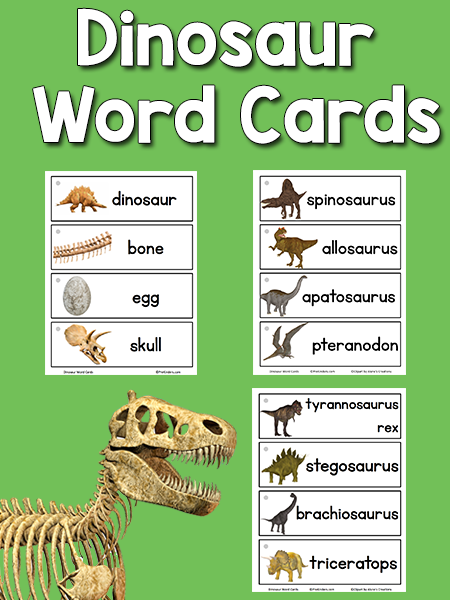
*use for pocket charts, flannel boards, graphing labels, matching, games, beginning sounds, etc.